Guides Feeding & Weight
18 months +
Feeding an adult Doberman
Updated November 2026 · By Owego Dobermans
The short answer
Feed a complete adult or all-life-stages food in two measured meals a day. Start with the bag's amount for your dog's ideal weight, then adjust by body condition: you should feel the ribs easily and see a waist. Slow down fast eaters, keep treats small, and weigh your dog every month.
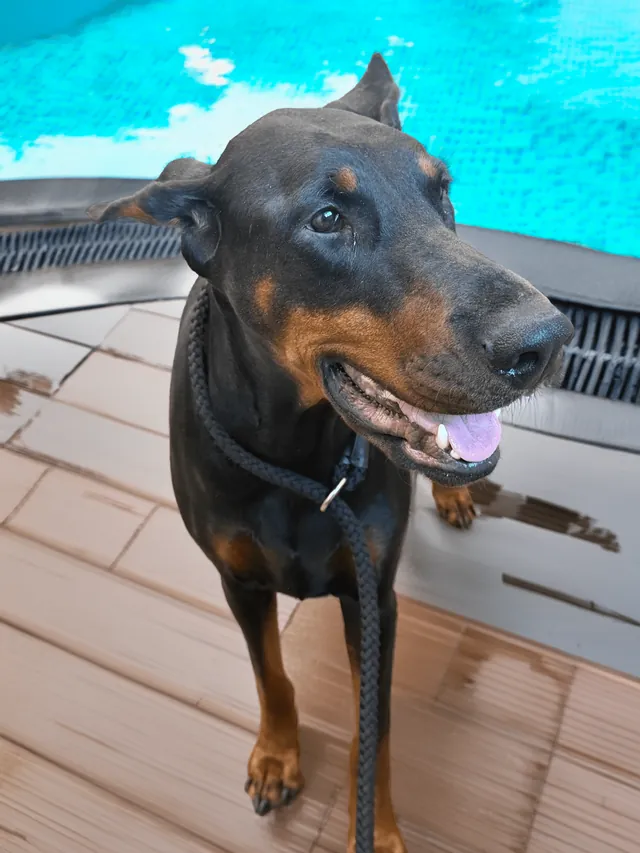
Once a Doberman stops growing, the goal changes from steady growth to holding a lean, muscular weight for life. Extra weight puts strain on joints and the heart, both of which matter in this breed.
Moving off puppy food
Most Dobermans finish most of their growth between 12 and 18 months. Ask your vet when to switch, then change over gradually across 7 to 10 days by mixing more of the new food in each day. If your dog already eats an all-life-stages food, there's nothing to switch. For the growing months, see feeding a Doberman puppy on our puppy guide.
How much to feed
There isn't one right number of cups. Calorie needs vary with size, age, activity, whether your dog is neutered, and the food itself. Use this order:
- Start with the amount on the bag for your dog's ideal weight, not their current weight.
- Measure every meal with a real measuring cup.
- Weigh your dog every month and check body condition every couple of weeks.
- Adjust by about 10% at a time and recheck in 2 to 3 weeks.
Body condition: the hands-on check
Vets use a body condition score (BCS) to judge fat, not just weight. The WSAVA publishes free 9-point charts; most healthy dogs score 4 or 5.
| Check | Ideal | Too heavy |
|---|---|---|
| Ribs | Easy to feel with light pressure, with a thin layer of fat | Hard to feel under fat |
| Waist from above | Clear hourglass behind the ribs | Straight or bulging sides |
| Belly from the side | Tucks up behind the ribs | Flat or sagging |
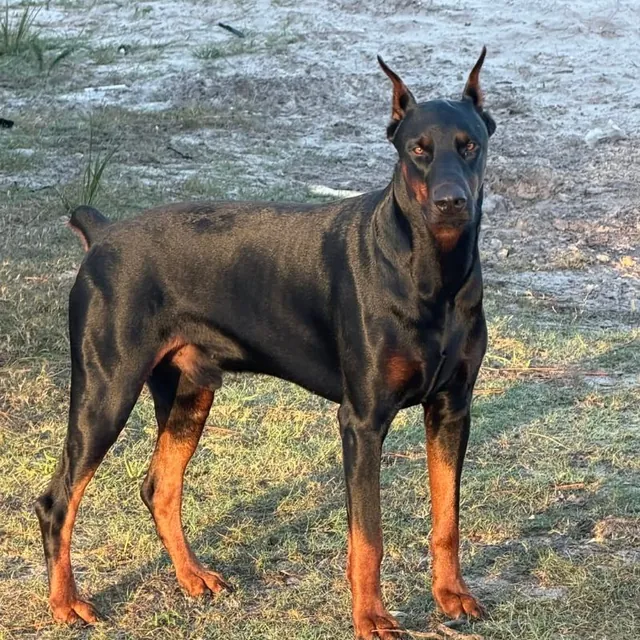
Dobermans should look athletic. If you can see every rib and hip bone, or your dog looks hollow over the back, talk with your vet about adding calories.
Feeding habits that lower bloat risk
Dobermans are on the AKC's list of deep-chested breeds at greatest risk of bloat (gastric dilatation-volvulus, or GDV). The AKC reports that dogs fed one meal a day are twice as likely to bloat as dogs fed two, and that fast eaters have five times the risk of slow eaters.
- Feed two meals a day rather than one large meal.
- Use a slow-feeder bowl if your dog gulps, and feed dogs apart if mealtime is competitive.
- Keep hard exercise away from mealtimes. Many vets suggest a calm hour before and after meals.
- Raised bowls aren't a fix. The AKC notes the research has been conflicting, so no firm recommendation can be made.
Emergency: a swollen, tight belly, retching with nothing coming up, drooling, restlessness or collapse can be bloat. Go to the nearest emergency vet right away. Even with treatment, the Merck Veterinary Manual puts the death rate at about 20%.
Treats and extras
A common rule of thumb is to keep treats to about 10% of daily calories. Use part of the meal as training rewards, and cut meals back on heavy-treat days. If your dog needs to lose weight, a vet-supervised plan works better than guessing.
What Owego does: our adult dogs eat a salmon-and-potato all-life-stages food with an omega fish oil added, in two meals a day. Ask your vet whether a similar approach suits your dog.
Food and heart health
Diet and DCM questions come up a lot with Dobermans. The short version is on our heart screening page: Doberman DCM is mainly inherited, so screening matters more than food choice, but it's still worth choosing a diet with your vet.
Frequently asked questions
How much should an adult Doberman eat?
It depends on the dog and the food. Start with the bag's amount for your dog's ideal weight, measure every meal, and adjust by about 10% at a time based on body condition.
When should a Doberman switch to adult food?
Usually around 12 to 18 months, once most growth is done. Ask your vet, and switch gradually over 7 to 10 days. Dogs on an all-life-stages food don't need to switch.
How many times a day should I feed my Doberman?
Twice a day. The AKC reports that dogs fed one meal a day are twice as likely to bloat as those fed two meals.